
A lightweight Python package — a proud one-trick-pony — designed to create good-looking, minimalistic, and lightning-fast brain surface visualizations featuring a distinctive contour overlay. Great for summarizing multiple whole-brain patterns, including the cerebellum!
Install
pip install "quickbrain @ git+https://github.com/pni-lab/quickbrain.git"Example
import nibabel as nib
from quickbrain import plot_brain
image = nib.load("path/to/your/image.nii.gz")
plot_brain(image)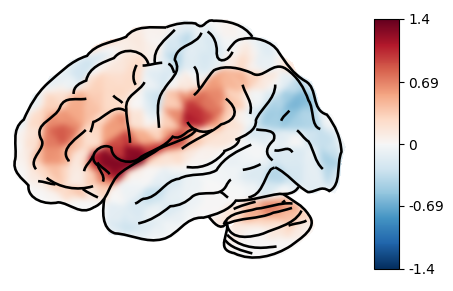
More examples
Open quickstart for a notebook walkthrough, then see quick API Documentation for the API generated from package docstrings.
When to use quickbrain
useful both for quick & dirty analyses and for publication-quality images
to provide a comprehensive, interpretable overview of whole-brain activation patterns
including the cerebellum (often omitted in other visualizations)
When to not use quickbrain
If you want high-resolution surface projections, and don’t care about the outline contour and the cerebellum, use the
nilearn.surface.plot_surf_stat_mapfunction.If you want precise localization, don’t use surface projection-based visualizations; use volumetric visualizations instead, e.g.
nilearn.plotting.plot_stat_map.
PRO:
simple
fast, viable for large composite images, e.g. for quick overview of whole-brain activation patterns
includes the cerebellum
overlays a contour to aid in interpretation
inflated meshes for better visualization of the insula and other deep sulcal structures
looks good!
CONTRA:
simple
as all visualizations that are based on meshes, it is suboptimal if you want fine-grained localization
only lateral and medial views
no nearest neighbor interpolation
Under the hood
The quickbrain package is built on top of the nilearn package, which provides a comprehensive set of tools for neuroimaging data analysis.
The trick is that we don’t need a high-resolution surface if we only want an overview of the whole-brain pattern, instead of detailed localization. Thus, the quickbrain package uses a custom-built low-resolution mesh (including the cerebellum!) and the nilearn.surface.vol_to_surf and the nilearn.surface.plot_surf_stat_map functions to project the statistical map onto the brain surface and plot the brain surface. This makes it lightning fast. But, low resolution means less details. So we put back the details by adding beautiful contour overlays, to guide the eye across sulci and gyri.
Dependencies
quickbrain keeps its runtime dependencies intentionally small:
matplotlibnibabelnilearnnumpyscipysvgpath2mpl
The documentation site is built with MyST Markdown in GitHub Actions; MyST is
installed there with npm and is not a Python package dependency of
quickbrain.
Developers, contributors and contact
Tamas Spisak
Center for Translational Neuro- and Behavioral Sciences (C-TNBS), University Medicine Essen, Germany
orcid: 0000-0002-2942-0821
email: tamas
.spisak@uk -essen .de